


Voca Buddy
- alliehe
- Jan 27, 2025
- 3 min read

Updated: Apr 1, 2025
Case Study
September – December 2024
Deliverables: Speech-to-Text Device Prototype, Mobile App, Video Demo
Team of 2
Project Overview
The deaf and hard-of-hearing (HoH) community faces daily challenges in communication, particularly in real-time conversations. Many existing speech-to-text solutions are expensive, unreliable in noisy environments, or too complex for certain users, such as older adults or students who cannot use smartphones freely in class.
To address this, my team developed Voca Buddy, a portable, standalone speech-to-text device designed for real-time transcription in various settings, such as classrooms, workplaces, and casual conversations. Unlike traditional phone-based apps, Voca Buddy is a dedicated device with external microphones for improved accuracy, customizable settings via a companion mobile app, and simple controls for ease of use.
Our goal was to bridge the accessibility gap by creating an affordable and intuitive assistive tool, ensuring deaf and HoH individuals can communicate more seamlessly without relying on smartphones or expensive services.
Video Demo: https://youtu.be/FiXpY82ck3I?si=qe3yXi64LISXDAwo Figma Prototype Link: https://www.figma.com/proto/j8mATUOzsuRIv7fxTK9xsL/Voca-Buddy?node-id=0-1&t=R5XlHUyPDIEYf285-1



My Contributions
Role: Designer / Researcher
Conducted user research through interviews with deaf and HoH individuals to understand their daily communication struggles and preferences.
Designed Voca Buddy's interface and built the physical prototype, ensuring it is intuitive and aesthetically pleasing
Led usability testing, gathering feedback from users and refining the design to enhance accessibility and efficiency.
The Problem
Accessibility Challenges: Many deaf and HoH individuals struggle with real-time conversations, especially in environments where hearing aids or cochlear implants may not be sufficient.
Existing Speech-to-Text Limitations: Most speech-to-text solutions rely on smartphones, which may be difficult for older adults or prohibited in certain settings (e.g., classrooms, workplaces). Additionally, many apps struggle with background noise, overlapping speech, and speaker differentiation.
High Costs: Many professional-grade transcription devices are prohibitively expensive, making them inaccessible for many users.
The Solution
Voca Buddy is a portable, standalone device with an integrated screen and external microphones that enhance speech recognition. It features:
Real-time transcription displayed on a high-contrast screen for improved readability
External microphones to enhance speech recognition in noisy environments
Physical buttons & joystick controls for easy navigation—designed for less tech-savvy users
Bluetooth connectivity to pair with a companion mobile app, allowing for customization and conversation history storage
Affordability—designed to be cheaper than premium alternatives like LiveScrypt ($1755 + hourly fees)
The Voca Buddy App allows users to:
Customize font size, language, and button functions.
Review past conversations stored on the device.
Type responses on the app that display on the device for two-way communication.
The Process
User Research
We parsed over 300 reddit posts and comments from the community, learning from individual in the community's pain points and frustration. Then we conducted semi-structured interviews with individuals who use cochlear implants and other accessibility tools
Key insights included:
A strong preference for accurate and reliable speech-to-text devices.
Frustration with existing smartphone-based tools, especially for older users.
Interest in customizable settings, such as font size adjustments and programmable shortcut buttons
Design & Prototyping
I created the high-fidelity prototype in Figma, designing both the Voca Buddy screen interface and the companion mobile app
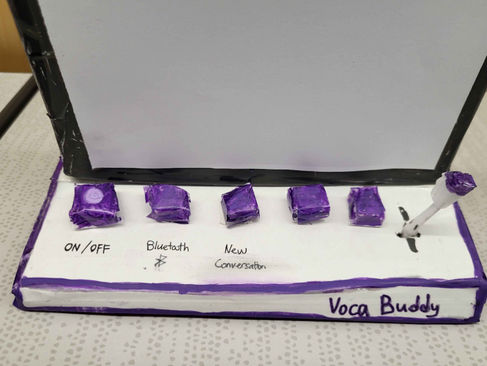
Physical Device UI:
Minimalist display for easy readability.
Physical buttons for key functions (power, Bluetooth, conversation reset).
Joystick for text size adjustment.


Mobile App UI:
Simple navigation with only two tabs: "Type" and "Settings" for intuitive use.
Easy device pairing via Bluetooth.
Customization options for colors, fonts, and button functions.



Usability Testing & Feedback
We tested Voca Buddy with a cochlear implant user and received professional feedback from industry professional Keita Ohshiro, a researcher in deaf and hard-of-hearing accessibility
✅ Positive Feedback:
Users appreciated the reliability of external microphones, which improved speech recognition.
The simplified interface made it easy to use, especially for older adults.
The cost-effective design was well-received, as many users struggle with the high price of assistive technology.
🔄 Improvements Based on Feedback:
Narrowed use cases to focus on school and conference settings, where users only need to listen.
Addressed the "hearing fatigue" issue by ensuring the device is comfortable for extended use.
Results
After refining Voca Buddy, we demonstrated it to potential users and accessibility experts, who found it to be:
More reliable than smartphone-based apps in noisy environments.
Simpler and more user-friendly than existing solutions, especially for older users.
A cost-effective alternative to high-end transcription devices.
This project successfully explored affordable, real-time accessibility tools, making communication more inclusive for the deaf and HoH community
Video Demo: https://youtu.be/FiXpY82ck3I?si=qe3yXi64LISXDAwo


Comments